

Ghee Market Witnesses Strong Growth Driven by Health Trends and Premium Product Innovation
ghee market
The ghee market is expanding steadily as health-conscious consumers drive demand for premium, organic, and functional dairy products.
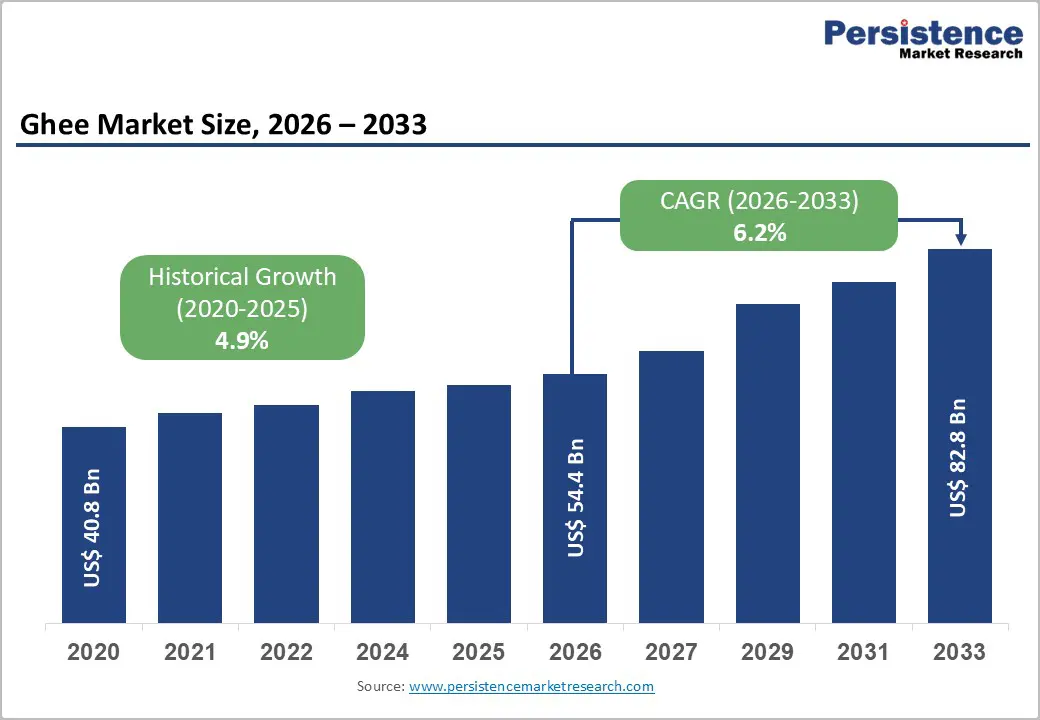
LONDON, UNITED KINGDOM, June 3, 2026 /EINPresswire.com/ -- The global ghee market is projected to reach a valuation of US$ 54.4 billion in 2026 and is expected to expand to US$ 82.8 billion by 2033, reflecting a compound annual growth rate (CAGR) of 6.2% during the forecast period. Ghee, a clarified form of butter, has been an integral component of traditional diets for thousands of years. Known for its rich taste, cultural significance, and potential health benefits, ghee has moved beyond its South Asian and Middle Eastern origins to gain popularity in global markets, driven by the rising adoption of dietary trends like Ayurveda and the ketogenic diet.
Download Your Free Sample & Explore Key Insights: https://www.persistencemarketresearch.com/samples/35184
Market Drivers and Opportunities
Increasing consumer awareness of health and wellness has shifted preferences away from refined vegetable oils and trans fats toward natural, minimally processed fats. Ghee has emerged as a key beneficiary of this transition due to its nutrient-dense profile, including omega-3 and omega-9 fatty acids, butyric acid, and fat-soluble vitamins. Nutritionists and integrative medicine practitioners endorse ghee for its potential gut health benefits, supporting its growing adoption across households, health-focused restaurants, and functional wellness products.
Premiumization presents a major growth opportunity, particularly in the A2 and organic ghee segments. A2 ghee, derived from cows producing the A2 beta-casein protein, is gaining traction due to perceived superior digestibility and nutritional advantages. Consumers are willing to pay a premium for A2 and organic variants, creating lucrative avenues for manufacturers investing in traceability, certification, and digital marketing strategies.
Market Restraints
Despite its high smoke point, ghee remains vulnerable to oxidative rancidity when exposed to heat, moisture, or light. Maintaining product quality requires robust cold-chain infrastructure, which remains underdeveloped in parts of South and Southeast Asia, Sub-Saharan Africa, and Latin America. Elevated distribution costs and shorter shelf-life in tropical climates constrain market expansion, particularly in price-sensitive regions.
Source and Segment Analysis
Cow milk ghee dominates the market, accounting for an estimated 58% share in 2026. Its popularity stems from its high content of beneficial fatty acids, superior digestibility, and immunity-boosting properties. A2 cow ghee is especially preferred among health-conscious consumers, attributed to its lactose-free composition and alignment with Ayurvedic practices. Buffalo milk ghee, rich in fat-soluble vitamins such as A, D, E, and K, is expected to witness steady growth due to its nutritional benefits.
Household consumption remains the primary end-use segment, holding around 55% of the market share in 2026. Cultural significance, multi-purpose culinary applications, and seasonal consumption spikes during festivals drive this dominance. The foodservice segment is the fastest-growing, supported by rising adoption of ghee in restaurants, cloud kitchens, and premium bakery applications, fueled by demand for authentic flavors and clean-label ingredients.
Get Custom Insights Designed for Your Businecss: https://www.persistencemarketresearch.com/request-customization/35184
Regional Insights
Asia Pacific dominates the global ghee market, holding 64% of the market share in 2025, with India as the primary driver. India’s per capita consumption of ghee is among the highest globally, reinforced by cultural, culinary, and religious practices. Domestic production exceeds 6 million metric tonnes annually, with significant exports to North America, the Middle East, and Southeast Asia. Secondary markets in South Asia, including Pakistan and Bangladesh, and diaspora-driven demand in Southeast Asia, further strengthen regional dominance. China and Japan are emerging as potential growth markets, driven by increasing disposable incomes and premium food adoption.
North America represents the fastest-growing market, led by the U.S. and Canada, driven by dietary trends like keto and paleo, and the presence of a significant South Asian diaspora. E-commerce platforms have enhanced accessibility, while advanced cold-chain logistics and regulatory support ensure product quality and consumer trust.
The Middle East and Africa exhibit traditional and culturally rooted consumption patterns. In countries such as Iran, the UAE, Saudi Arabia, Kenya, Ethiopia, and Somalia, ghee is essential in local cuisines, ceremonial dishes, and energy-rich foods, such as spiced and herb-infused variants like Niter Kibbeh.
Market Segmentation
By Source
Cow Milk Ghee
Buffalo Milk Ghee
Goat Milk Ghee
Others
By Variety
Traditional Ghee
Flavored Ghee
A2 Ghee
Cultured Ghee
Others
By Nature
Organic
Conventional
By Application
Food Processing Industry
Foodservice Industry
Household Consumption
Others
By Distribution Channel
B2B
B2C
Supermarkets/Hypermarkets
Convenience Stores
Specialty Stores
Online Retail
Others
By Region
North America
Europe
East Asia
South Asia & Oceania
Latin America
Middle East & Africa
Checkout Now & Download Complete Market Report: https://www.persistencemarketresearch.com/checkout/35184
Competitive Landscape
The ghee market is moderately fragmented, comprising large organized players, regional cooperatives, and emerging direct-to-consumer brands. Key market leaders include GCMMF (Amul), Heritage Foods, Patanjali Ayurved, ITC Limited, and international players such as 4th & Heart and Ancient Organics. Companies are focusing on product innovation, geographic expansion, e-commerce penetration, and premiumization through A2 and organic ghee offerings. Strategic investments, partnerships, and functional product developments, such as fortified and botanical-infused ghee, continue to shape market dynamics.
Key Developments
Recent industry developments include FMF Foods’ launch of Amul Cow Ghee in Fiji in 2025, RKG Agmark Ghee’s collaboration with South India Chef’s Association, Nova Dairy’s introduction of A2 Cow Ghee, and Aterian Inc.’s investment in U.S.-based 4th & Heart, signaling increasing international expansion and premium market focus.
Conclusion
The global ghee market is witnessing robust growth fueled by rising health consciousness, premiumization trends, and expanding applications across households, foodservice, and functional wellness sectors. While logistical challenges persist, innovations in A2 and organic ghee, alongside strategic regional expansion, present significant opportunities for stakeholders seeking long-term growth and global market penetration.
Read Related Reports:
Low-fat Cheese Market: The low-fat cheese market is projected to grow from US$103.3 Bn in 2026 to US$172.5 Bn by 2033, at a CAGR of 7.6% during 2026-2033 market analysis 2026.
Canola Oil Market: The global canola oil market will rise from US$40.7 billion in 2026 to US$55.0 billion by 2033, growing at a CAGR of 4.4% during forecast years.
Persistence Market Research
Persistence Market Research Pvt Ltd
+1 646-878-6329
email us here
Visit us on social media:
LinkedIn
Instagram
Facebook
YouTube
X
Legal Disclaimer:
EIN Presswire provides this news content "as is" without warranty of any kind. We do not accept any responsibility or liability for the accuracy, content, images, videos, licenses, completeness, legality, or reliability of the information contained in this article. If you have any complaints or copyright issues related to this article, kindly contact the author above.
